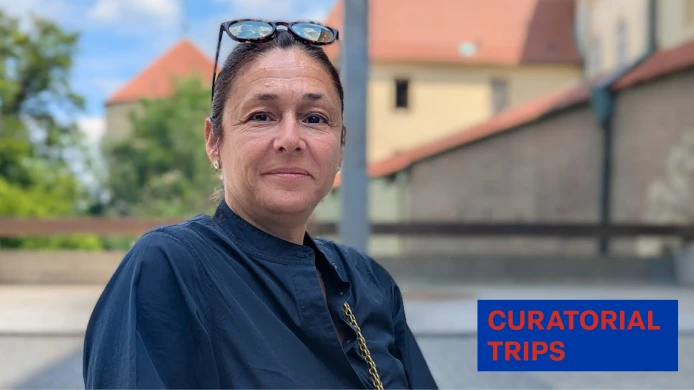
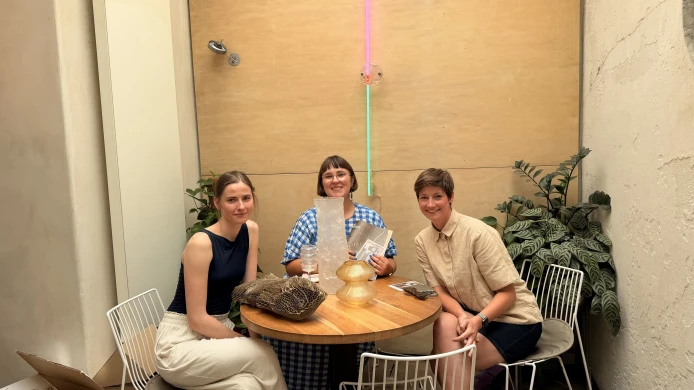
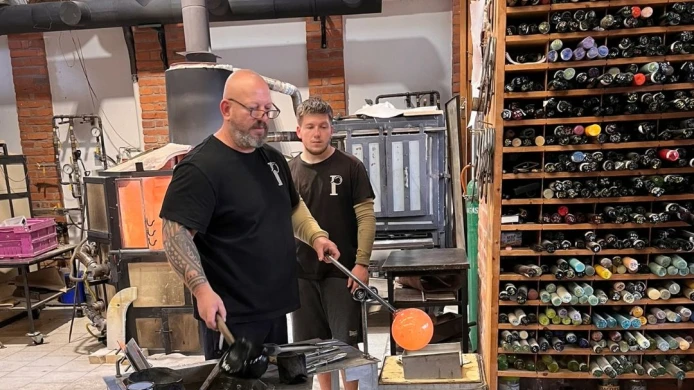
Between 9–11 June, a professional visit took place from the Taiwanese institution The National Taiwan Craft Research and Development Institute. The study trip of two participants, Hsu Pi-Hsien and Liao Hsuan-Chun, focused on traditional Czech craft heritage. Throughout the visit, they had the opportunity to meet several tradition bearers, and the programme was designed to provide the visitors with a comprehensive overview of living craft traditions in the Czech Republic, their history, techniques, and the possibilities of transmitting them to future generations.
The first stop in Mělník was the tradition bearer, basket maker Petr Král. He introduced the materials used, their properties, and individual working processes. The visit also included a presentation of his work. Another meeting took place in the studio of Michaela Dandová in Mnichovo Hradiště, who specialises in traditional weaving from bulrush. The visitors had the opportunity to see both historical and contemporary products, to become familiar with the natural material, and its various uses. In Krouna, the programme continued with a visit to Zdeněk Bukáček, a maker of traditional turned wooden figurines. He presented the production process using alder wood and created a typical Krouna figurine on site. The day concluded with a visit to the Museum in Nature Vysočina in Hlinsko, where a guide introduced traditional craftsmen’s dwellings from the turn of the 19th and 20th centuries. The visitors were thus able to connect craft techniques with the historical way of life of their makers.
On the second day, the visitors in Strážnice met with the director of the National Institute of Folk Culture, Martin Šimša. Here they had the opportunity to view current exhibitions dedicated to folk costume in Moravia and musical instruments. This was followed by a tour of the traditional Strážnice indigo dyeing workshop of the Joch family. The Taiwanese visitors appreciated the presentation of the entire indigo dyeing process. The final stop was the ceramist Karel Hanák in Násedlovice, who presented the production of traditional Haban pottery.
The programme continued the following day in Prague, where the visitors saw the exhibition of the Ethnographic Museum of the National Museum in Prague. In the afternoon of the last day, the curators were introduced to the maker of traditional Easter eggs Ondřej Kareš, and to straw weaving presented by tradition bearer Markéta Bartáková. She introduced the material possibilities and the visitors also had the opportunity to try the technique themselves. The final presentation was by Pavel Šrytr, who introduced the techniques and motifs of traditional Podještědí embroidery.
The entire visit provided a valuable space for sharing experience, inspiration, and the development of international cooperation in the field of safeguarding traditional crafts.